The Texas rig is a soft-plastic bait with its hook point tucked back into the body, so it can crawl through weeds, rocks and wood. Vermont Fish & Wildlife calls it "a rig commonly utilized by bass anglers." Texas Parks & Wildlife's magazine calls it "the granddaddy of them all."
Quick answer: Slide a cone-shaped weight onto your line, tie on a worm hook, then thread the bait so the hook point ends up buried in the plastic. Let it sink to the bottom and work it back slowly (Vermont Fish & Wildlife; NYSDEC).
What it is
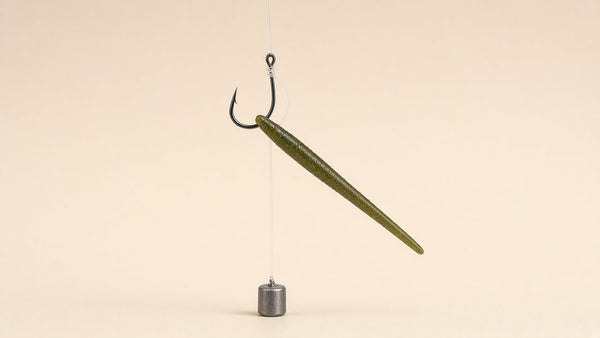
- The parts: "a cone-shaped weight threaded onto the main fishing line, followed by a hook that is tied to the line" (Vermont Fish & Wildlife).
- Weight is optional: the rig "can also be fished weightless" (Vermont Fish & Wildlife).
- The baits: worms, craws, creature baits, lizards, tube baits, frog-style baits and baitfish imitators can all be Texas-rigged (Vermont Fish & Wildlife).
How to rig it
Vermont Fish & Wildlife's steps (source):
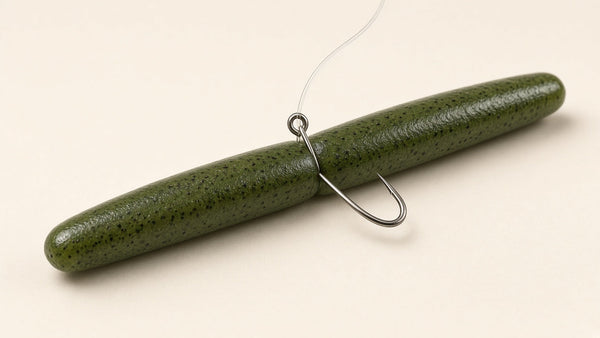
- Thread the cone-shaped weight onto your main line, then tie on the hook.
- Push the hook point "between ¼ and ½ of an inch into the top part of the plastic bait in a top-to-bottom direction." A longer bait may need you to go further in.
- Push the point out the side of the bait, then slide the bait up the hook "onto the bend in the hook just below the hook eye."
- Thread the hook "half-way into the lower end of the bait, keeping the hook point covered by the soft plastic."
Check your work: Virginia DWR says that, done correctly, "your lure should sit straight in line with the hook" (Virginia DWR).
Hook styles for the Texas rig
- Offset or wide gap worm hooks. Virginia DWR's instructions start: "Using a wide gap or offset worm hook" (Virginia DWR).
- Sizes one agency suggests: NYSDEC's bass table lists a "2/0 to 4/0 worm hook" with a "1/4-1/2-oz. worm weight" and a "6-10-inch ribbon tail rubber worm" (NYSDEC).
- Match the hook to the fish: Virginia DWR adds that "hooks come in a variety of styles and sizes, so be sure to pick one that best suits your target species or style of fishing."
Choosing a weight
- Start light: Vermont says "Conventional wisdom is to use just enough weight for the lure to reach the bottom."
- Why go heavier: "a heavier weight, at times, will generate reaction strikes from nearby fish that may aggressively respond to the bait's faster rate of fall in the water" (Vermont Fish & Wildlife).
- Too heavy or too light: Virginia DWR says that if the weight is too heavy, "the lure will drag the bottom and risk getting snagged," while one that is too light "may not reach the depth you are targeting."
- Variations: Texas Parks & Wildlife lists fishing with no sliding weight ("weightless Texas rig") and "pegging" a weight "so it doesn't slide at all" (TPWD).
How to fish it
- NYSDEC: "Let it sink to the bottom and slowly drag it back, or move it a few feet, let it sit for a few seconds and then move it again." The table pairs it with water "In or around vegetation" (NYSDEC).
- Setting the hook: Texas Parks & Wildlife says "Most of the time when using the Texas rig, a forceful, powerful hookset is required." Its rigging tips aim to "make sure the hook penetrates through the plastic when you set the hook."
Why it works
- It goes where fish hide. Because the point is covered, Vermont says the rig can be "retrieved through all types of cover such as submerged vegetation, rocks and wood without 'hanging up.'"
- Exposed hooks snag. Texas Parks & Wildlife puts it plainly: "Exposed hooks snag on nearly everything they contact."
- Who it's for: Vermont lists "Primarily bass, pike and pickerel, though other warm water species may be caught."
Sources
- Vermont Fish & Wildlife Department, "Bottom Lures – Texas Rig." https://vtfishandwildlife.com/fish/fishing-opportunities/fishing-basics/common-lures-and-rigs/bottom-lures-texas-rig
- New York State Department of Environmental Conservation (NYSDEC), "Fishing for Largemouth and Smallmouth Bass." https://dec.ny.gov/things-to-do/freshwater-fishing/learn-to-fish/tips-skills/fishing-for-largemouth-smallmouth-bass
- Virginia Department of Wildlife Resources, "Try Throwing a Texas Rig!" (Aug 7, 2024). https://dwr.virginia.gov/blog/try-throwing-a-texas-rig/
- Texas Parks & Wildlife magazine, "Rigging Up, Not Wigging Out," Texas Fishing 2013 (Randy Brudnicki). https://tpwd.texas.gov/publications/pwdpubs/media/fishing_rigs.pdf
Keep going: Wacky Rig · Drop Shot · Essential Knots
Always check your state's current fishing regulations before you go. Last checked: Nov 5, 2026 (America/Los_Angeles).