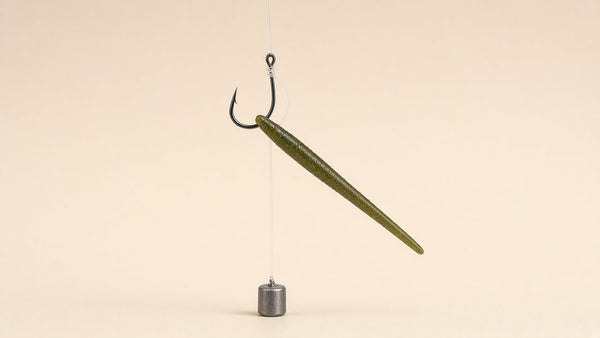
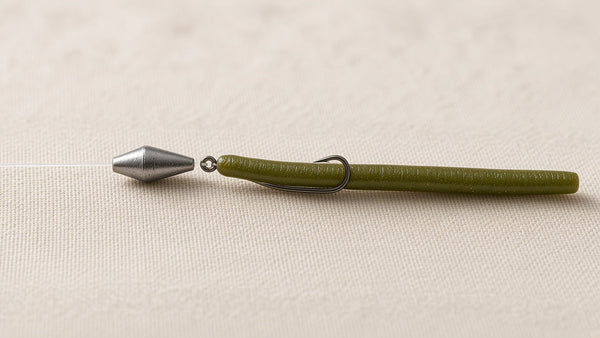
The wacky rig hooks a soft bait through its middle instead of its end. Vermont Fish & Wildlife calls it "a subtle, finesse approach for catching fish." It is "most often fished by bass anglers on or near the bottom."
Quick answer: Run an open hook through the middle of a soft worm, cast, and let it sink slowly. Add a twitch or two, then let the water do most of the work (Vermont Fish & Wildlife).
What it is
- Hooked in the middle: where many rigs hook the top or bottom of a bait, "the wacky rig features an open hook that is rigged into the mid-section of the bait – often a soft plastic worm or live night crawler" (Vermont Fish & Wildlife).
- With or without weight: the rig "can be fished with or without weight" (Vermont Fish & Wildlife).
How to rig it
- Tie a hook to your line. Texas Parks & Wildlife says to "Tie on a small hook" (TPWD).
- "Simply thread your hook completely through the middle section of your bait of choice, exposing the hook point" (Vermont Fish & Wildlife).
Save your worms with an O-ring. Texas Parks & Wildlife notes a drawback: "nearly every time you catch a fish the plastic rips." Its fixes: - "Slide an O-ring on the worm and run the hook through the O-ring." - Or "put a short piece of shrink tubing on the worm and then run the hook through the tubing and worm."
Hook styles for the wacky rig
- Circle or octopus hook: NYSDEC's bass table lists a "4-inch rubber stickworm, o-ring, size 1/0 circle or octopus hook" (NYSDEC).
- Around cover: Texas Parks & Wildlife says "In cover, use a weedless hook."
- Sized to the fish: Vermont says the "hook and bait style and size can be tailored by the angler to fit the species they are targeting."
How to fish it
- Let it fall: NYSDEC says "Let it slowly sink, after it hits bottom raise it up and let it fall again."
- Watch your line: "sometimes you can see a hit/tap (line moves) before you feel it" (NYSDEC).
- Don't overwork it: Vermont warns against "over-fishing" the setup. "Inject small twitches into your rod tip to give the bait subtle action, but let the natural current or wave action of the water you're fishing provide most of the movement."
- Depth and line: Vermont says the rig "is generally fished on lighter-weight fishing line" and "typically shines in water less than 10 feet deep," though it "can be weighted to be fished effectively in deeper water."
Why it works
- A slow, lifelike fall. Vermont describes "a slow-falling and subtle fish-tempting action that can be made to appear life-like with a simple upward twitch or two of fishing rod tip."
- Less is more. Letting the water move the bait "creates an ultra-life-like presentation in the water that is hard for fish to resist" (Vermont Fish & Wildlife).
- Texas Parks & Wildlife's view: "The wacky rig has a unique, slow descent rate and action."
- Not just for bass: Vermont says it "can be an effective setup for targeting an assortment of fish from walleye and pike to trout and salmon."
Sources
- Vermont Fish & Wildlife Department, "Bottom Lures – Wacky Rig." https://vtfishandwildlife.com/fish/fishing-opportunities/fishing-basics/common-lures-and-rigs/bottom-lures-wacky-rig
- New York State Department of Environmental Conservation (NYSDEC), "Fishing for Largemouth and Smallmouth Bass." https://dec.ny.gov/things-to-do/freshwater-fishing/learn-to-fish/tips-skills/fishing-for-largemouth-smallmouth-bass
- Texas Parks & Wildlife magazine, "Rigging Up, Not Wigging Out," Texas Fishing 2013 (Randy Brudnicki). https://tpwd.texas.gov/publications/pwdpubs/media/fishing_rigs.pdf
Keep going: Texas Rig · Drop Shot · Essential Knots
Always check your state's current fishing regulations before you go. Last checked: Nov 5, 2026 (America/Los_Angeles).