Line is what connects you to the fish. Oklahoma's Department of Wildlife Conservation says "There are three main types of fishing line available on the market today: monofilament, fluorocarbon and braid." The wall of spools at the store is mostly those three, in different pound-test strengths.
Quick answer (our summary): Start with monofilament. NY DEC calls mono "the best choice for beginning anglers," and "Eight-pound test is a good all-around line weight" — if the rod and reel are rated for it. Pound test is roughly the force the line is built to take before it breaks (Vermont Fish & Wildlife). Match the line to the rod and reel labels (Oklahoma). Replace mono regularly (NY DEC; Washington Department of Fish and Wildlife, WDFW). Never leave old line behind: use a recycling bin, or take it home and cut it into small pieces before you throw it away (WDFW; California State Parks).
This page teaches you how to choose fishing line, why mono, fluorocarbon and braid behave differently, what pound test to start with, how to spool the reel, how to use a leader, how to avoid line twist, and when to replace and recycle the line. Pair it with How to Choose a Fishing Rod, How to Choose a Fishing Reel, and How to Choose a Rod and Reel Combo. For a single matched example, see Your First Rod, Reel & Line. For knots, see Essential Knots. Check license and water rules first: Fishing by State.
What pound test means, and why it has to match the gear
Vermont Fish & Wildlife says a "pound-test" rating, "in common terms, is essentially the amount of weight, force or pressure that a specific line is designed to withstand before breaking." The same agency notes that real-world strength "may end up being more or less than the number set by a fishing line manufacturer" once you take into account the rod, the reel and drag, the lure, and the water.
Match line to the rod and the reel. Oklahoma: "always stay within the line and lure weight classification ranges that your rod and reel recommend on their labeling." Those ratings "are tailored for monofilament line," so "if using fluorocarbon or braided line make sure to match the diameter equivalent." The same pound test "for each of these three types of fishing line have differences in overall line diameter" (Oklahoma; the agency's grammar).
Why it matters: pound test is not a free choice you make after you buy the rod. If you put line outside the printed range, or you spool braid by pound test alone and ignore diameter, you are asking the rod and reel to do a job they were not labeled for. A reel-size number on the box is not a cross-brand standard; read the model's monofilament capacity. See How to Choose a Fishing Reel.
Starter strengths from NY DEC: - Bluegill and yellow perch: "when fishing for bluegills and yellow perch, 4- to 8-pound test line is good." - Bass: "When fishing for bass, use 8- to 12-pound test line." - All-around: "Eight-pound test is a good all-around line weight."
The U.S. Fish and Wildlife Service (USFWS) first-time guide lists "4- to 12-pound-test monofilament fishing line" among the items to bring. The two agencies' ranges overlap, so either is a fine place to start — as long as the number you pick sits inside the rod's and reel's printed ranges. These are starting points, not a command to put 4-pound line on a rod that is not rated for it, and not a heavy-cover prescription.
NY DEC also offers "an ultra-light action rod and reel with four-pound test line for bluegill fishing" as an option. South Dakota GFP: an ultra-light rod "should be strung with a light line and can be used to cast very light lures."
Monofilament ("mono")
What it is: "a single strand of synthetic plastic material" (Vermont).
Why agencies start people here. NY DEC: "monofilament line (mono) is the best choice for beginning anglers." "Mono is inexpensive and works well in most fishing situations." Oklahoma: "monofilament line floats and has the most stretch-ability of the three types of line." That stretch, Oklahoma says, is "allowing you time to get a good hook set."
Vermont says monofilament's buoyancy and stretch are why it is used for "top water lure fishing or crankbait fishing."
Watch out: "monofilament tends to degrade quicker than other lines from heat, sun and water exposure" (Vermont). NY DEC: "Old monofilament line becomes brittle and loses its strength." "Mono has a memory" and, if it has sat on a reel, "will curl easily and create tangles."
Why it matters: mono is the practical first main line — it is what NY DEC starts beginners on, it floats, and its stretch gives you a little time on the hookset (Oklahoma). The cost of that is faster breakdown and memory, which is why you replace it regularly and keep spare spools out of heat and sun.
Fluorocarbon ("fluoro")
What it is: Vermont: "Fluorocarbon line is a more rigid line," and "it is much denser and tends to be far less buoyant" than monofilament. We are not saying it "sinks"; Vermont's wording is "far less buoyant."
Why anglers use it. Oklahoma: "its nearly invisible under water" (the agency's grammar). Vermont: that rigidity "enables it to provide anglers with greater sensitivity of fish strikes, bottom composition and underwater habitat, as well as better hook sets."
NY DEC, under its Leaders heading, says: "Fluorocarbon is used for line-shy fish such as trout because fluorocarbon blends into the water so the fish cannot see it." That is NY DEC's leader-context sentence, not a claim that fluoro must be your main line for trout.
Oklahoma notes that most anglers use fluorocarbon as a leader rather than a main line, "which is why most still use it as a leader instead of a main line" — and, in Oklahoma's words, "it is still about twice as expensive as monofilament line."
Watch out: Vermont says fluorocarbon lines "are less advantageous for tactics that require a more buoyant or stretchy line." If the tactic needs a floating or stretchy line — Vermont's examples for mono are topwater and crankbaits — fluoro is the weaker choice for that job.
Why it matters: fluoro's job is usually a leader — a short, less-visible, more-sensitive section at the end of the main line — especially for wary fish in clear water. It is not an automatic upgrade for every spool.
Braided line ("braid")
What it is: "braided or woven synthetic fibers" (Vermont).
Why anglers use it. Vermont: braid is well-known for "high strength, durability, abrasion resistance, lack of stretch and overall power in respect to its diameter." Vermont's "when to use": "around heavy aquatic cover such as underwater vegetation or submerged wood, in murky or discolored bodies of water and as backing to more subtle fluorocarbon or monofilament leaders."
Watch out: "most types are highly visible" (Vermont). Because braid of the same pound test is a different diameter than mono, "make sure to match the diameter equivalent" on the rod and reel labels (Oklahoma).
Why it matters: braid's job is thin, strong main line in heavy cover or stained water, usually tied to a fluoro or mono leader so the fish sees less of it (Vermont). It is a later step, not a first spool. We are not assigning a specific braid pound test to a species; the sources used here do not do that.

Leaders: a short piece between the main line and the lure
NY DEC: "A leader is a short piece of line or wire that connects your main fishing line to your bait or lure." "Wire is used for sharptoothed fish, such as pike and pickerel" (NY DEC's spelling). "Fluorocarbon is used for line-shy fish such as trout because fluorocarbon blends into the water so the fish cannot see it" (NY DEC, under Leaders).
Oklahoma: most anglers use fluorocarbon as a leader instead of a main line. Vermont: braid is used "as backing to more subtle fluorocarbon or monofilament leaders."
Oklahoma's typical length, for a braid-to-fluorocarbon leader: "Three feet is typically enough leader when connected to braided line." The same paragraph notes that anything longer "will require casting your connection knot through the guides of the rod which can lead to abrasion and knot failure," but "may be necessary when using light spinning equipment in super clear water or if the fish are finicky." Oklahoma's close: "It's really just up to what you as an angler are comfortable with." That is Oklahoma's typical starting point and its own caveats, not a required length for every setup.
Why it matters: a leader lets you keep a main line that casts or holds up in cover (mono or braid) and still present a less-visible or more abrasion-minded section next to the fish. For the knots that join line to a hook, lure or swivel, see Essential Knots. We are not teaching a specific leader knot on this page, and we are not picking a winner between knot types for braid.

Which line should I pick?
Our quick summary of the agency advice above. Pound tests are from NY DEC; leader and braid uses are from Oklahoma and Vermont (see the sections above). This is not a table from any one agency. Stay inside the rod's and reel's printed ranges. Check bait, tackle and access rules for the water you will fish — some waters are artificial-only, and some have special tackle rules.
| If this is the job | What agencies point you toward | Why that choice matters |
|---|---|---|
| A first spool, most freshwater situations | Monofilament, as the main line. NY DEC: "the best choice for beginning anglers." "Eight-pound test is a good all-around line weight," if the rod and reel are rated for it. USFWS's first-time range is 4- to 12-pound-test monofilament. | Mono "works well in most fishing situations" (NY DEC), floats, and has the most stretch of the three types (Oklahoma). |
| Pond or lake panfish (bluegill and similar) | Mono, 4- to 8-pound test (NY DEC). An ultra-light outfit with four-pound test is an option (NY DEC), only if the rod and reel are rated for it. | Light line for light lures and smaller fish. See Bluegill. |
| Pond or lake bass | Mono, 8- to 12-pound test (NY DEC). Recheck the rod and reel ratings if you step up. This is not a heavy-cover prescription. | Heavier line only works if the gear is rated for it (Oklahoma). See Largemouth Bass. |
| Clear water, wary fish, including trout | A mono (or later, braid) main line with a fluorocarbon leader. NY DEC: fluorocarbon "is used for line-shy fish such as trout because fluorocarbon blends into the water." Oklahoma: most anglers use fluoro as a leader. | The leader is the less-visible section next to the fish. This is two credited sentences, not one merged rule. |
| Topwater lures or crankbaits | Monofilament (Vermont: "top water lure fishing or crankbait fishing," where buoyancy and stretch are useful). Fluorocarbon is "less advantageous" when you need a more buoyant or stretchy line (Vermont). | The line's float and stretch are the point of the tactic. |
| Heavy weeds or wood, or murky water — once you are comfortable | Braid as a main line, with a fluoro or mono leader (Vermont). Match the diameter equivalent on the labels (Oklahoma). | Thin, strong, abrasion-resistant line in cover; a leader to keep what the fish sees more subtle (Vermont). |
| Pike and pickerel | NY DEC: a wire leader, because "Wire is used for sharptoothed fish, such as pike and pickerel." | A short wire section is NY DEC's answer for sharp teeth. |
Spooling: how to put line on the reel
NY DEC, under "Tips for avoiding line twist with a spinning reel": "Put the line on your reel correctly. Follow the instructions included in the line packaging." NY DEC, in its basic chapter, also says: "Look for instructions on how to tie line to your reel in the package of line you purchase."
Leave room at the rim. "For best casting, don't put too much line on your reel. Leave 1/8-inch of space from the edge of the reel's spool" (NY DEC). That is NY DEC's exact figure, including the hyphen; we are not converting it or adding another unit on this page.
Pre-spooled reels. "When purchasing a reel that comes pre-spooled with line, it's best to put fresh line on the reel." "Mono has a memory (stays in the shape it was stored in). If pre-spooled line has been on a reel for a while, it will curl easily and create tangles" (NY DEC).
Help spooling it. NY DEC's saltwater guide: "Your local tackle store can sometimes spool line onto your reel for you, or you can do it yourself."
Tighten as you go, and after a cast. "To prevent tangles, always tighten your line on the spool before reeling in" (NY DEC). "After making a cast, flip the bail over by hand instead of using the reel handle. Then, grab the line just above the reel and give it a slight tug before you start reeling. This will remove any loops before they start" (NY DEC).
Why it matters: most first-day tangles come from line that was put on wrong, packed too full, or left in a loop after the bail closed with the handle. The packaging, the 1/8-inch gap, and a hand-closed bail are the sourced fixes. For the reel side of capacity and drag, see How to Choose a Fishing Reel.

Line twist: what to do on a spinning reel
NY DEC flags "annoying line twist" as the disadvantage of spinning reels. The same chapter gives the prevention steps above (spool by the packaging, close the bail by hand, tug the line, tighten before reeling).
If you already see a loop: do not cast it. NY DEC: that "will result in a worse tangle." Instead, "open the bail and 'strip' line off the reel until you pull the loop out. Then, close the bail and begin reeling in, keeping your line tight as you reel."
If twist keeps coming back: "If your line keeps twisting, it's time to put new line on the reel" (NY DEC).

Why it matters: twist is not just messy. It is one of the reasons a good drag and a matched spool still fail on the water. The first response is the bail-and-tug routine, not a new reel. Persistent twist means new line, not a different knot. For knots, see Essential Knots. (Our longer line-twist and knots guide is in draft and is not linked here until it is published.)
When to replace fishing line
- The knot test. NY DEC: "If your line breaks easily after tying a knot, it's time to replace it."
- At least once a year, for mono. NY DEC: "You'll land more fish if you replace your line at least once a year." TPWD, on line in general: "All lines degrade over time and use. Exposure to ultraviolet rays of the sun will hasten the degradation of line." "Replace line once a year."
- When it is damaged or brittle. WDFW: "Replace your monofilament line regularly, as it can become damaged or brittle over time." NY DEC: "Old monofilament line becomes brittle and loses its strength. This can lead to broken line and a lost fish."
- When twist will not clear. "If your line keeps twisting, it's time to put new line on the reel" (NY DEC).
- Keep spare line out of heat and sun. Mono "tends to degrade quicker than other lines from heat, sun and water exposure" (Vermont). Vermont also says anglers "should consider changing their monofilament line on a regular basis."
Why it matters: line is the one part of the outfit that actually touches the fish, and it wears out. Sun, time and memory all shorten it (Vermont; NY DEC; TPWD). The sourced rule of thumb is yearly for mono, and sooner if a knot test, brittleness or persistent twist says so.
Recycle or dispose of old line — never leave it behind
Why it matters. WDFW estimates that "monofilament line takes 600 years to break down once discarded" — that is WDFW's estimate, in WDFW's words ("It is estimated…"). Loose line "can get wrapped around a fish's gills or a bird's beak and cause amputation, or even death" (WDFW). California State Parks: "Fishing line discarded in our waterways also fouls boat propellers."
What to do. - Use a line recycling bin where you find one. Some states run programs: Florida Fish and Wildlife Conservation Commission (FWC) has a statewide Monofilament Recovery and Recycling Program (MRRP); WDFW has "more than 140 recycling receptacles at freshwater and marine fishing locations across the state"; "The California State Parks" and partners "have placed recycling containers at various locations throughout the State." Ask your state wildlife agency about bins near you. - Put "only used fishing line" in the bin. "Dispose of lures, bait, and other trash in garbage cans" (WDFW). - No bin nearby? Take it home. California State Parks says line sent to a landfill can still harm wildlife "unless it is cut into small pieces." - Pick up line you find. "A little time picking up line and litter could save a life" (WDFW). - See an animal tangled in line? WDFW: "Report tangled animals immediately." "Injured or entangled animals can also be reported to local wildlife rehabilitation centers." Contact your state wildlife agency or a local rehab center.
Common beginner mistakes
- Buying by pound test alone, without reading the rod and reel labels. Stay within the printed ranges (Oklahoma). Those ranges are tailored for monofilament; match the diameter equivalent for fluoro or braid.
- Spooling braid as if it were the same thickness as mono of the same pound test. It is not (Oklahoma).
- Leaving old pre-spooled mono on the reel. NY DEC: put fresh line on; mono has memory and will curl and tangle.
- Overfilling the spool. Leave "1/8-inch of space from the edge of the reel's spool" (NY DEC).
- Closing the bail with the handle after a cast. Close it by hand, then tug the line above the reel (NY DEC).
- Casting when you already see a loop. That "will result in a worse tangle" (NY DEC). Strip the loop out first.
- Treating fluorocarbon as a line that "sinks," or as an automatic main-line upgrade. Vermont: "far less buoyant." Oklahoma: most anglers use it as a leader.
- Leaving old line on the bank or in the water. Recycle it, or take it home and cut it into small pieces (WDFW; California State Parks).
Common questions
These answers restate the sourced advice on this page. They are for readers. They are not a rich-result claim.
Mono vs fluorocarbon vs braid — which should I start with? Monofilament. NY DEC: "monofilament line (mono) is the best choice for beginning anglers." Fluorocarbon is used especially as a leader (Oklahoma); NY DEC, under Leaders, says it "is used for line-shy fish such as trout because fluorocarbon blends into the water so the fish cannot see it." Braid is Vermont's choice around heavy cover or in murky water, usually as a main line with a more subtle leader — a later step.
What pound test line should I use for bass, trout or panfish? NY DEC: 4- to 8-pound test "is good" for bluegills and yellow perch; 8- to 12-pound test for bass; "Eight-pound test is a good all-around line weight." USFWS's first-time range is 4- to 12-pound-test monofilament. For trout, NY DEC discusses fluorocarbon as a leader for line-shy fish; it does not give a separate trout pound-test number in the sources used here, so we are not inventing one. Always stay inside the rod's and reel's printed ranges (Oklahoma).
Do I need a leader? Not on every first spool. A leader is "a short piece of line or wire that connects your main fishing line to your bait or lure" (NY DEC). Use a fluorocarbon leader when you want a less-visible section next to the fish — Oklahoma notes that most anglers use fluoro as a leader; NY DEC discusses fluorocarbon under Leaders, for "line-shy fish such as trout"; a mono or fluoro leader at the end of braid (Vermont; Oklahoma), or a wire leader for sharp-toothed fish such as pike and pickerel (NY DEC). Oklahoma's typical braid-to-fluoro starting length is three feet, with Oklahoma's own caveats. Tie the lure end with a knot from Essential Knots.
How much line should I put on the reel? Follow the line packaging (NY DEC). Leave "1/8-inch of space from the edge of the reel's spool." NY DEC's starter spinning example is a reel that can hold 80 to 150 yards of 8-pound-test monofilament — an example of capacity, not a universal fill. Do not overfill.
When should I replace fishing line? If it "breaks easily after tying a knot" (NY DEC); at least once a year for mono (NY DEC; TPWD says "Replace line once a year"); when it is "damaged or brittle" (WDFW); or when "your line keeps twisting" after you have already tried NY DEC's bail-and-strip steps. Heat, sun and water break mono down faster than other lines (Vermont).
What causes line twist, and how do I fix it? On a spinning reel, NY DEC calls line twist the main disadvantage. Prevent it by spooling from the packaging instructions, closing the bail by hand, tugging the line, and tightening before you reel. If you see a loop, do not cast; strip it out (NY DEC). If twist persists, put new line on the reel.
Keep going
- Choose the matching rod: How to Choose a Fishing Rod.
- Choose the matching reel: How to Choose a Fishing Reel.
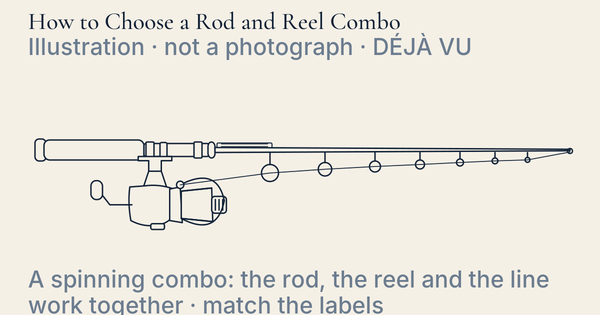
- Put them together as a set: How to Choose a Rod and Reel Combo.
- A single matched starter setup: Your First Rod, Reel & Line.
- Tie the line on: Essential Knots.
- Permission and rules: Fishing by State. California readers can also use our license guide.
- Back to Start Here or the Guides hub.
Practice a clean spool and the knot test, then record the line you used in the Catch Log. Our free Water & Light chart helps you choose when and where to go next. The DÉJÀ VU™ First Cast Kit is on the way. Join the waitlist to hear first.
Always check current regulations for your state and water. Rules change, and some waters have special tackle or bait rules. Fishing by State. Sources last verified Oct 29 and Nov 5, 2026 PT; source URLs reconfirmed HTTP 200 on Nov 13, 2026 PT.
Sources
- NY DEC, I FISH NY Beginners' Guide to Freshwater Fishing, Ch. 2 — https://extapps.dec.ny.gov/docs/fish_marine_pdf/gsfishing2.pdf
- NY DEC, I FISH NY Beginners' Guide to Freshwater Fishing, Ch. 5 — https://extapps.dec.ny.gov/docs/fish_marine_pdf/gsfishing5.pdf
- NY DEC, Getting Started in Saltwater Fishing — https://extapps.dec.ny.gov/docs/fish_marine_pdf/nycswgetstar.pdf
- Oklahoma Department of Wildlife Conservation, Choosing the Right Fishing Line — https://www.wildlifedepartment.com/outdoorok/ooj/choosing-right-fishing-line
- Vermont Fish & Wildlife, Fishing Lines — https://www.vtfishandwildlife.com/fish/fishing-basics/fishing-lines
- U.S. Fish and Wildlife Service, A Guide to Fishing for the First Time — https://www.fws.gov/story/guide-fishing-first-time
- Washington Department of Fish and Wildlife, Monofilament Recovery — https://wdfw.wa.gov/fishing/monofilament-recovery
- Florida Fish and Wildlife Conservation Commission, Monofilament Recovery and Recycling Program — https://mrrp.myfwc.com/about/
- California State Parks, Fishing Line Recycling — https://dbw.parks.ca.gov/?page_id=29426
- Texas Parks & Wildlife, Fishing Gear Maintenance and Repair — https://tpwd.texas.gov/education/angler-education/fishing-gear-maintenance-and-repair.pdf
- South Dakota GFP, FISH South Dakota Book Part One, Ch. 2 Equipment — https://gfp.sd.gov/UserDocs/nav/FISHSouthDakotaBook_PartOne_(1).pdf