A fishing rod, South Dakota Game, Fish and Parks (GFP) says, works as "an extension of the angler's arm to propel a hook or lure into water." Choosing one is less about collecting models and more about matching the rod to the reel, the line and lure you will actually use, and the fish and water you have in mind.
Quick answer: For a first freshwater rod, look at a mid-length, medium-action spinning or spincast rod, then read the printed line and lure-weight ranges before you buy. Power is how much force it takes to bend the rod. Action is where it bends. Those two labels are not the same thing. Wildlife agencies do not pick one official "winner"; they give starting points, which we summarize below.
This page teaches you how to choose a fishing rod, why power, action, length, materials and guides matter, and what each setup is for — pond panfish, bass, trout, lakes and piers. For a single matched rod, reel and line example, see Your First Rod, Reel & Line. Check license and water rules for your state first: Fishing by State.
Start with the job, then read the label
Vermont Fish & Wildlife's advice for choosing a rod is to consider "what lure weights and line sizes you will be using with the rod most often, as well as the general size of the fish species you'll be targeting." That is the job. The label is how you check that the rod can do it.
Most rods have length, action and recommended line weight printed near the base of the handle (South Dakota GFP). New York State's Department of Environmental Conservation (NY DEC) says "rod action, ideal line and lure sizes is written just above the rod handle." Oklahoma's Department of Wildlife Conservation says to stay within the "line and lure weight classification ranges that your rod and reel recommend on their labeling," and notes that those ratings "are tailored for monofilament line," so if you use fluorocarbon or braid, match the diameter equivalent.
Why this comes first: a "medium" sticker alone is not the compatibility check. Power and action are separate labels. The printed ranges are what you match.
Power: what the rod can handle, and why it matters
Vermont calls power (also "weight") "how much force or weight it takes to bend the rod." Different powers, Vermont says, "are designed [to] handle specific ranges of lure weights and line sizes" (the agency page is missing the word "to"; the meaning is the designed range). Powers typically run from extra-light to heavy.
South Dakota GFP describes the same idea as the rod's "strength or lifting power," "related to the weight of the line it can handle and the lure weights it can cast most effectively." Its example: "an ultra-light rod should be strung with a light line and can be used to cast very light lures."
Why it matters: if you put line or lures outside the rod's designed range, you are asking it to do a job it was not built for. A light rod with light line is the right tool for small lures and smaller fish; a heavier power is built for heavier line and lures. Always read the actual printed ranges. We are not prescribing a universal "medium power" — South Dakota GFP's beginner recommendation, below, is about action, which is a different label.
Action: where the rod bends, and why it matters
Vermont says action "is determined by where the flex occurs along the rod." Faster-action rods "tend to flex more near the tip"; moderate or slower-action rods "tend to flex more into the middle and lower sections."
South Dakota GFP uses slightly different wording. It describes action as "how much the rod bends when pressure is put on the tip": a fast-action rod is "stiffer" and "will bend only near the tip," and a slow-action rod "will bend all the way into the lower portion of the rod." North Dakota Game and Fish describes action as the rod's "ability to flex when under the strain of a fish." NY DEC calls action "how flexible a rod is." The agencies agree it is about flex; they do not all define it the same way.
Why it matters, in South Dakota GFP's words: "Fast-action rods provide better sensitivity to a bite and faster hook-setting capability, but medium-action rods provide more casting distance." The same agency says "medium-action rods are a good choice for beginning anglers." NY DEC's starter spinning recommendation is also a "medium action" rod. That is a starting point, not a required action for every water or species.
Length: why it matters, and what agencies suggest
South Dakota GFP says length "depends largely on the angler's preference," and that most rods are two-piece and "between 5 and 6½ feet long." For a start, it calls "a 5½-foot rod" "a good length."
Other agencies start a little longer. North Dakota's "most versatile" pick is a "6-7 foot, medium action, spinning rod." NY DEC calls "a medium action 6- to 6 ½-foot spinning rod" "a good all-around starter rod." For spincasting, NY DEC tells beginners to "use a rod that is your height or shorter for better control."
Why it matters: the one length reason we can source directly is control. NY DEC's beginner advice is shorter (your height or less) for better control. The agencies do not, in the sources used here, give a single official length, and they do not state that a longer rod automatically casts farther (South Dakota GFP's "more casting distance" line is about medium action, not length). Our summary of the agency advice above: for a first rod, look in the mid-length range those agencies name — roughly 5½ to 7 feet — and use NY DEC's "your height or shorter" guidance when control matters, as it often does for a first spincast setup.
Materials, guides and the handle
Materials. Most rods are graphite, fiberglass, or a combination (South Dakota GFP). Vermont says spinning and baitcasting rods are "commonly made of graphite or fiberglass," and that spinning rods come in single- and multi-piece versions. The sources we used state those materials; they do not compare sensitivity, weight or durability, so we are not assigning those qualities here.
Guides (eyelets). South Dakota GFP says line guides "control the line during the cast and distribute the stress on the rod when pressure is applied to the line." On most rods they are graduated, "with larger rings near the reel and smaller near the tip," which "help reduce the friction of the line on the guides as it uncoils during the cast." That is why guide condition matters: damaged guides add friction and stress. Texas Parks & Wildlife (TPWD) lists "damaged guides" and "damage to reel seats and handles" among things to inspect. South Carolina DNR warns that hooking through a guide ring "can damage the guide eye."
Handle and reel seat. The handle is where you hold the rod; the reel seat is where the reel attaches (part names from South Dakota GFP's rod diagram; the short descriptions are our plain-English explanations). The printed ratings sit near the handle, which is why you look there before you buy. We do not have an agency comparison of handle materials, so we are not recommending one.


Match the rod to the reel
North Dakota notes that "there are different types of rods for different types of reels." The practical rule is: the guides must line up with the reel.
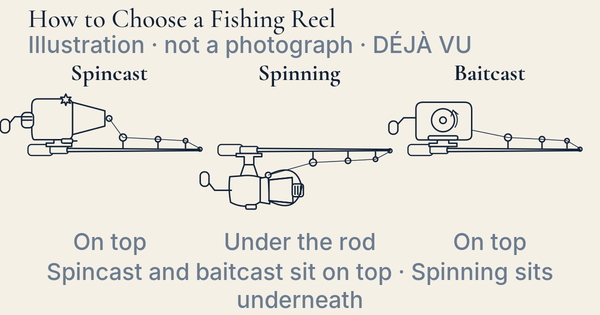
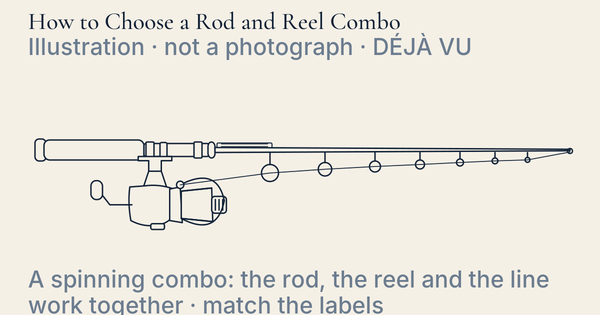
- Spinning rods. Guides are mounted on the bottom, "in order to line up with the reel" (Vermont). NY DEC notes they have "larger line guides mounted on the underside" and "a much wider range of lengths and rod action." Vermont calls them "known for their versatility" and says they "are used regularly by anglers targeting everything from panfish and trout to bass, walleye, northern pike and catfish." Spinning is "considered the most versatile" by NY DEC "since it can cast light and moderately heavy lures/baits."
- Spincasting rods. The reel sits on top of the rod (NY DEC; Vermont). NY DEC recommends "a spin-casting rod and reel" for beginning anglers, and says most people start with one "because it is easy to use." It also says spincast reels "usually perform best on light- to medium-action rods."
- Baitcasting rods. The reel and guides sit on top (Vermont; South Dakota GFP). NY DEC lists bait-casting and fly rods as "the hardest to use."
- Fly rods. South Dakota GFP: they "are much longer and often break down into several pieces." This page does not teach fly fishing.

Spinning or spincasting first? Agencies differ a little. NY DEC recommends spincasting for beginners and calls spinning the most versatile. North Dakota's most versatile pick is a medium-action spinning rod. Our summary: either is a fine starting point, as long as the rod type matches the reel and the printed ratings match the line and lures you will use. An existing suitable setup is not a reason to buy again.
A simple decision path
The table below is our summary of the agency advice on this page. It is a teaching path, not an official required combination and not a universal specification. Match the printed ratings on the actual rod. Check bait, tackle and access rules for the water you will fish.
| If this is the job | What agencies point you toward | Why that choice matters |
|---|---|---|
| A first pond or lake trip from open shore | NY DEC: a medium-action, 6- to 6 ½-foot spinning rod is "a good all-around starter rod." North Dakota: a 6–7-foot, medium-action spinning rod is "most versatile." South Dakota GFP: a 5½-foot rod is "a good length," and medium action is "a good choice for beginning anglers." Or start with a spincast rod, your height or shorter, for control (NY DEC). | One mid-length, medium-action rod covers a lot of first trips. NY DEC's spinning example is the setup we walk through in Your First Rod, Reel & Line. |
| Pond or lake panfish (bluegill and similar) | NY DEC: 4- to 8-pound-test line "is good" for bluegills and yellow perch, and "you may use an ultra-light action rod and reel with four-pound test line for bluegill fishing." Vermont: spinning rods are used regularly for panfish. | An ultra-light rod is designed for light line and very light lures (South Dakota GFP). Stay inside the rod's printed ranges; do not put 4-pound line on a rod that is not rated for it. See our Bluegill profile. |
| Pond or lake bass | NY DEC: "When fishing for bass, use 8- to 12-pound test line." Vermont: spinning rods are used regularly for bass. Recheck the rod and reel ratings if you step up in line. This is not a prescription for pulling fish through heavy cover. | Heavier line only works if the rod is rated for it (Vermont; Oklahoma). See Largemouth Bass. |
| Trout, including streams | Vermont: spinning rods are used regularly for trout. South Dakota GFP: an ultra-light rod "should be strung with a light line and can be used to cast very light lures." | The sources used for this draft do not give a stream-specific length. For tighter quarters, NY DEC's general beginner advice is a rod "your height or shorter for better control" (given for spincasting). Match the printed light-line and light-lure ranges. |
| Piers, and longer or deeper casts | NY DEC's saltwater beginner guide: "start with a spinning reel" and "make sure the line weight, rod line rating, and reel size match." Vermont: a typical spincast reel's "smaller spool sizes make them less advantageous for long casts or deeper water fishing." | The sources used here do not give a pier-specific rod length, so we are not prescribing one. On a pier, "look around before you cast" (NY DEC) and read Staying Safe on the Water. For the reel side of longer or deeper casts, see How to Choose a Fishing Reel. |
Common beginner mistakes
- Buying from a generic label instead of the printed ranges. "Medium" is not a substitute for the line and lure-weight ranges on the rod (Vermont; Oklahoma; South Dakota GFP).
- Mismatching the rod and the reel. A spinning reel belongs on a spinning rod, with the guides underneath. A spincast or baitcast reel sits on top, with the guides on top (Vermont; South Dakota GFP; NY DEC).
- Confusing power with action. Power is how much force it takes to bend the rod; action is where it bends (Vermont; South Dakota GFP). Medium action is the beginner recommendation several agencies give; that is not automatically "medium power."
- Running with a rod, or carrying it tip-first through trees. NY DEC: "Always walk when holding your fishing rod. Don't run!" Carry it "tip up and behind you so it comes through the brush and trees easier."
- Hooking through a guide ring. South Carolina DNR: use the hook holder if the rod has one; hooking through a guide "can damage the guide eye." NY DEC's alternative is to "attach the hook to a rod line-guide when not fishing" so it does not swing into branches or people. If your rod has a hook holder, prefer that; otherwise follow NY DEC's method and inspect the guide for damage.
- Leaving a rod where a door or a foot can break it. TPWD: "Many a rod has been broken in a vehicle door, trunk or tailgate, or accidentally stepped on." South Carolina DNR: "Don't lay your rod and reel on the ground. Whenever possible lean it up against something. This keeps dirt out of the reel and prevents the rod from being stepped on and broken." A rod case or tube is our suggestion for transport.
Care and safety
- Look around before you cast so the area is clear (NY DEC). For shore, pier and boat safety, read Staying Safe on the Water.
- Wash the rod "with warm mild soapy water and rinse thoroughly," then dry it fully (TPWD).
- After saltwater, "always hose it off with freshwater immediately after using" (South Carolina DNR).
- Inspect guides, the reel seat and the handle for damage (TPWD).
- Secure the hook as described above, and store the rod where it will not be stepped on or shut in a door.
Keep going
- Put a matching reel on that rod: How to Choose a Fishing Reel.
- A single matched starter setup: Your First Rod, Reel & Line.
- Tie the line on: Essential Knots.
- Permission and rules: Fishing by State. California readers can also use our license guide.
- Back to Start Here or the Guides hub.
Practice the setup, then record what you used in the Catch Log. Our free Water & Light chart helps you choose when and where to go next. The DÉJÀ VU™ First Cast Kit is on the way. Join the waitlist to hear first.
Always check current regulations for your state and water. Rules change, and some waters have special tackle or bait rules. Fishing by State. Sources last verified Oct 29 and Nov 5, 2026 PT; source URLs reconfirmed HTTP 200 on Nov 12, 2026 PT.
Sources
- South Dakota GFP, FISH South Dakota Book Part One, Ch. 2 Equipment — https://gfp.sd.gov/UserDocs/nav/FISHSouthDakotaBook_PartOne_(1).pdf
- Vermont Fish & Wildlife, Spinning Rods and Reels — https://www.vtfishandwildlife.com/fish/fishing-basics/fishing-rods-and-reels/spinning-rods-and-reels
- Vermont Fish & Wildlife, Casting Rods and Reels — https://www.vtfishandwildlife.com/fish/fishing-basics/fishing-rods-and-reels/casting-rods-and-reels
- North Dakota Game and Fish, Open-Water Rods — https://gf.nd.gov/fishing/equipment/open-water/rods
- NY DEC, I FISH NY Beginners' Guide to Freshwater Fishing, Ch. 2 — https://extapps.dec.ny.gov/docs/fish_marine_pdf/gsfishing2.pdf
- NY DEC, I FISH NY Beginners' Guide to Freshwater Fishing, Ch. 5 — https://extapps.dec.ny.gov/docs/fish_marine_pdf/gsfishing5.pdf
- NY DEC, Getting Started in Saltwater Fishing — https://extapps.dec.ny.gov/docs/fish_marine_pdf/nycswgetstar.pdf
- Oklahoma Department of Wildlife Conservation, Choosing the Right Fishing Line — https://www.wildlifedepartment.com/outdoorok/ooj/choosing-right-fishing-line
- Texas Parks & Wildlife, Fishing Gear Maintenance and Repair — https://tpwd.texas.gov/education/angler-education/fishing-gear-maintenance-and-repair.pdf
- South Carolina DNR, Beginner Guide to Saltwater Fishing — https://saltwaterfishing.sc.gov/pdf/BeginnerguidetoSWfishing.pdf